

How to Play Texas Hold'em Poker

How to Play and Win with Poker
That’s a great question! Poker is a game of skill, strategy, and psychology, not just luck. The most popular version is Texas Hold’em.
Here is a breakdown of how to play and key strategies for winning:
1. How to Play Texas Hold'em
The main goal is to make the best possible five-card poker hand using any combination of your two private hole cards and the five public community cards.
The Flow of a Hand
A hand of Texas Hold’em has four betting rounds, or “streets,” and starts with two forced bets, called Blinds.
Pre-Flop:
Each player is dealt two private hole cards.
The two players to the dealer’s left place mandatory bets called the Small Blind (SB) and Big Blind (BB).
The first betting round begins with the player to the left of the Big Blind. You can Fold (give up your hand), Call (match the Big Blind), or Raise (increase the bet).
The Flop:
Three community cards are dealt face-up on the board.
A second round of betting takes place, starting with the first active player to the dealer’s left.
The Turn:
A fourth community card is dealt face-up.
A third betting round occurs.
The River:
The fifth and final community card is dealt face-up.
The final betting round occurs.
Showdown:
If more than one player remains, they reveal their cards. The player with the best five-card hand wins the Pot (all the money/chips bet in the hand).
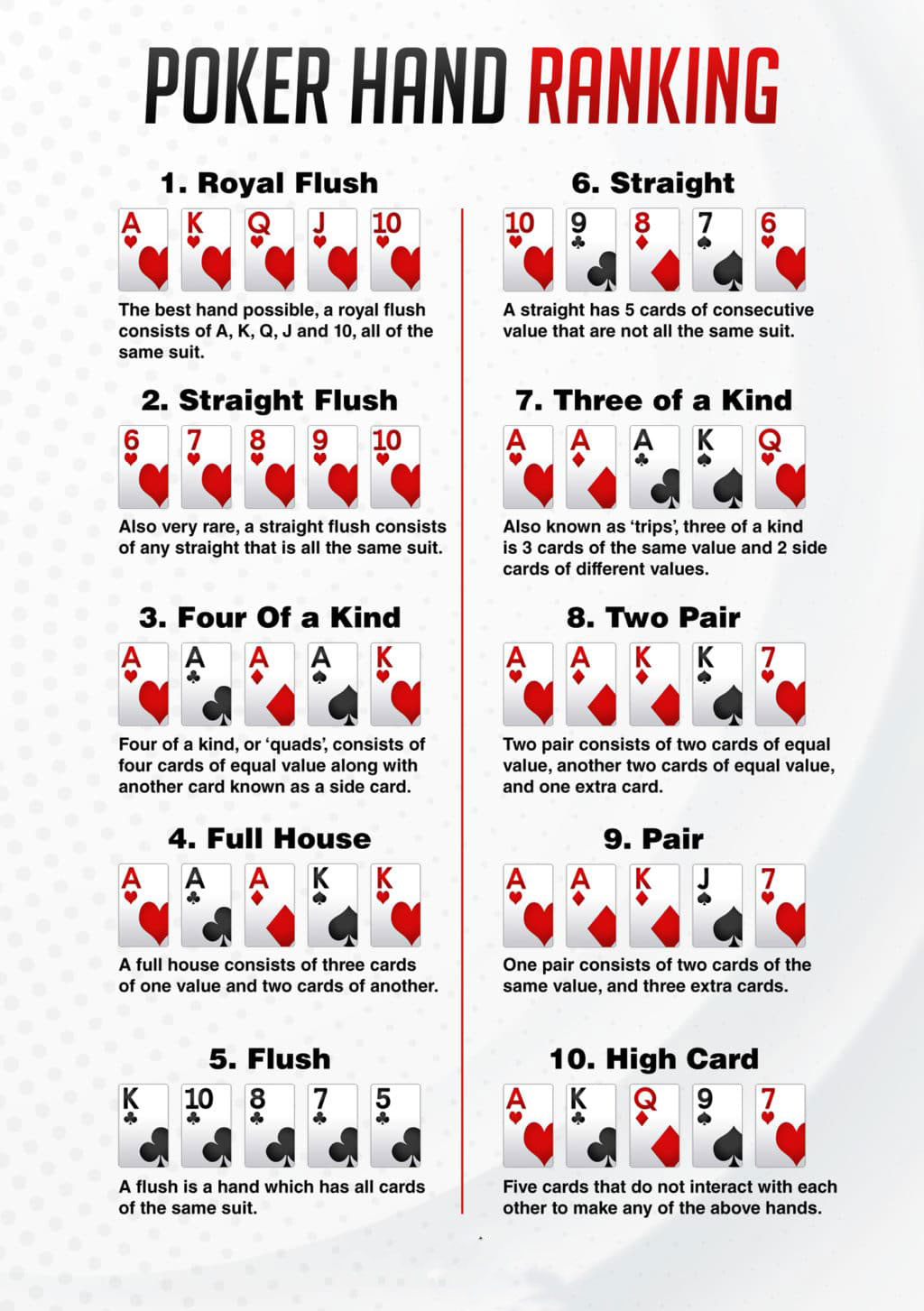
Poker Hand Rankings (Best to Worst)
Knowing the hand rankings is absolutely essential:
Royal Flush: A, K, Q, J, 10, all of the same suit.
Straight Flush: Five cards in sequence, all of the same suit (e.g., 9-8-7-6-5 of diamonds).
Four of a Kind: Four cards of the same rank.
Full House: Three cards of one rank and two cards of another rank (e.g., K-K-K-5-5).
Flush: Five cards all of the same suit, but not in sequence.
Straight: Five cards in sequence, but not all of the same suit.
Three of a Kind: Three cards of the same rank.
Two Pair: Two cards of one rank and two cards of a different rank.
One Pair: Two cards of the same rank.
High Card: When you have none of the above, your best card counts.
2. Key Winning Strategies
Winning consistently involves more than just getting good cards. Here are the top tips:
1. Play Fewer Hands, But Play Them Aggressively (Tight-Aggressive)
Be Patient: Beginners often play too many hands. You should fold far more hands than you play.
Play Strong Hands: Focus on premium starting hands like Pocket Aces (AA), Kings (KK), Queens (QQ), or Ace-King (AK).
Be Aggressive: When you do play a hand, play it aggressively by raising (betting or increasing a bet) instead of just calling (limping). Aggression builds the pot when you have a good hand and gives you more ways to win (by getting others to fold).
2. Understand Position
Your position at the table relative to the dealer button is crucial. Late position (acting last) is the most powerful because you get to see what everyone else does before you have to make a decision.
Play a wider range (more hands) when you are in a late position and a tighter range (fewer, stronger hands) when you are in an early position.
3. Observe Your Opponents ("Play the Player")
Pay attention to how your opponents play, even when you’ve folded.
Are they aggressive or passive?
Do they only bet when they have a strong hand?
Do they fold easily to bets?
Use this information to decide when to bluff or when to bet big for value.
4. Bluff with Purpose
Bluffing is betting with a hand you don’t think is the best, hoping your opponent folds.
Semi-Bluff: The most effective bluffs are semi-bluffs, where your hand currently is not the best, but it has a good chance of improving (e.g., you have a flush draw or a straight draw).
Bluff Less Against Beginners: Beginners are often described as “calling stations” who call bets too often, making bluffs less effective.

5. Bankroll Management and Mental Game
-
Bankroll Management: Only play with money you can afford to lose. A common rule is to have at least 25 to 30 buy-ins for the stakes you are playing. This helps you survive “downswings” (periods of bad luck).
-
Avoid Tilt: Tilt is a state of emotional frustration that leads to poor decision-making. If you start feeling angry or frustrated after a bad beat, the best strategy is to stop playing and come back another time.
Would you like to know more about pot odds and expected value, which is the mathematical foundation of advanced poker strategy?